

Will the goths like the new Pond album? Will the beer drinkers?
Australia's gold standard in psychedelic rock only cared about appeasing two audiences when making their eleventh album. They should have no issues there.

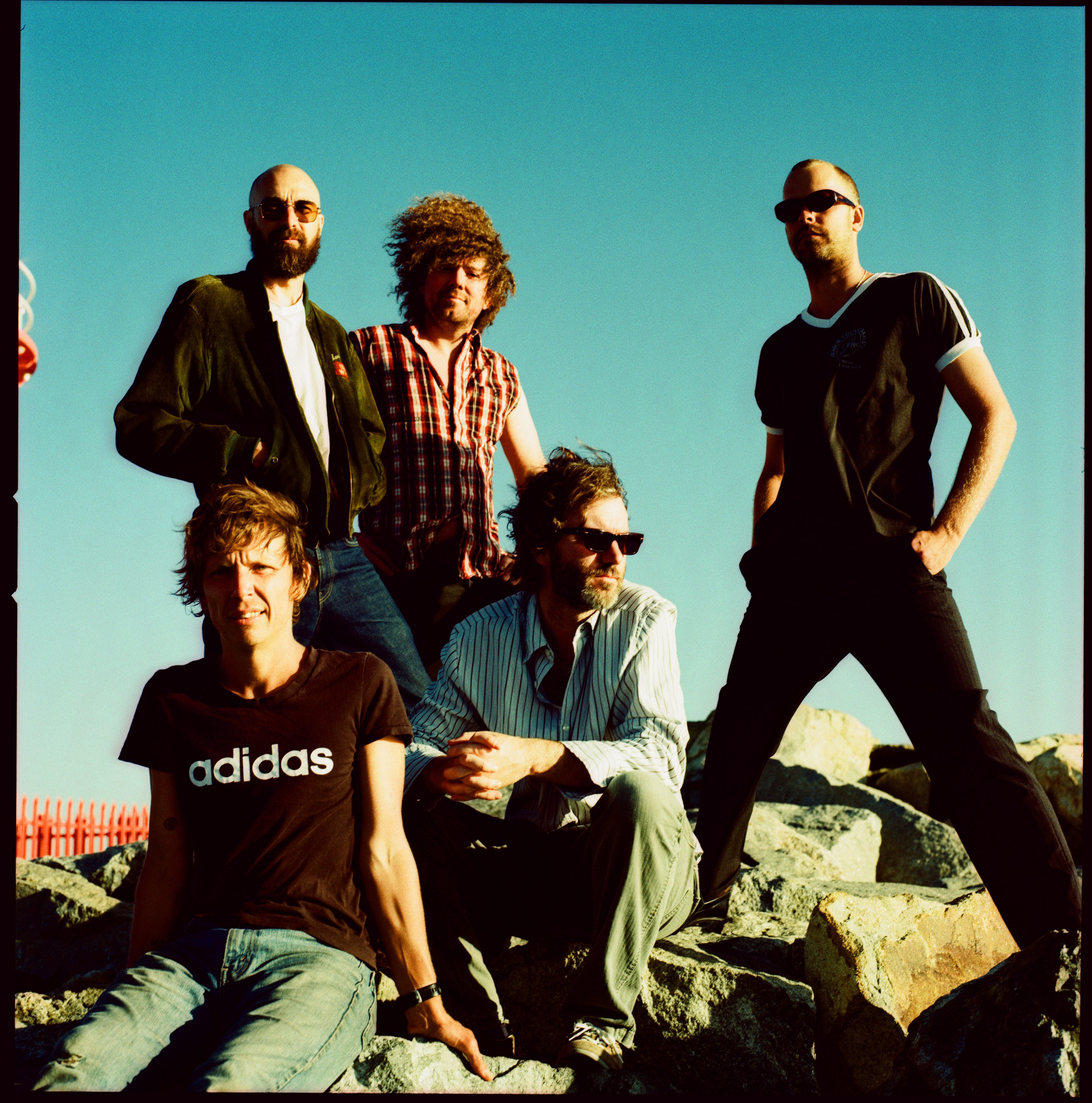
The subject line of the email says “goths at the pub”. Of course, I have to click on that. This may not be what you expected from Pond’s eleventh album Terrestrials (out June 19), given the two decades the band have spent carving out their niche as Australia’s finest psychedelic rock band.
But Pond bandleader Nick Allbrook begs to differ. As he tells me over Zoom from his home in Perth, gothic energy has been “a constant vein” dating back to his early years touring with good mate Kevin Parker’s band Tame Impala.
“If you look up a certain phase in Tame Impala’s history, you’ll see an emaciated, sallow Nick Allbrook with black hair and little skulls around his wrist,” he says. “We’ll always be a psychedelic band … but I think it’s all in the same family. A lot of my love of psychedelia is laced with violence and darkness.”
What is without a doubt a change of pace is the way Pond recorded Terrestrials. The band outlawed the fuzz pedal, a staple on previous releases, pushing themselves outside of their comfort zone.
“On tour, [Shiny] Joe [Ryan] kept playing this chord progression that inspired GUM [Jay Watson] to sing over it, like Ian Curtis or Bauhaus — you know, the deep goth voice,” Allbrook says. “When Joe and GUM started doing that, it was a bit of a eureka moment.”
The band also made a two-step test each song had to satisfy to make it onto the album: Would goths like it? Could you have a beer to this?
As a rule of thumb I try not to speak on behalf of goths or beer drinkers,1 but I’d say mission accomplished. Terrestrials doesn’t feel out of step with previous Pond albums, but it gives the band a new complexion.
Allbrook’s vocals, disentangled from the fuzziness, are the biggest beneficiary. Digging from the well of classic Australian pub rock, he channels anyone from Peter Garrett’s relentlessness on ‘Tourmaline’ to shades of the great Chrissy Amphlett’s flair on the sensationally campy ‘Personal Hell’. Album highlight ‘Roebuck Plains’ is the sort of song that we need to ensure reaches Jimmy Barnes at all costs.
The band seems to be having fun, too. Allbrook tells me that, at the core, the album is by Pond and for Pond — “sensitive blokes who love the pub”. One of the joys of a new Pond record is poring over each track and hearing the way the team switches instruments and styles at will. The well-oiled machine isn’t slowing down.
The bulk of Terrestrials came together in Seabird, an “end of the earth-style town”, where Pond rented a plasterboard shack next to a limestone block pub. It forms a mental image that feels in step with the tone of the album: dusty, reeking of beer on sticky carpet, and baked in a sort of heat so hot your grip on reality starts to wobble.
It invites an atmosphere that makes me think of Wake in Fright, the 1961 psychological thriller written by Kenneth Cook and adapted for film by Ted Kotcheff a decade later. I have a distinct memory of seeing the film for the first time in an empty cinema, deeply unsettled by the way it got under the skin of a hard-to-pin-down distinctly Australian ugliness. I ask Allbrook if that link is something I’m pulling from thin air.
“[Wake in Fright] sums up so much of this album,” he says. “The horror and awe, the desperate, desperate, desperate camaraderie, and a silence in the face of a deep, deep trauma, a collective trauma that we can’t overcome.”
“Facing it with silence and getting pissed, it seems to be one of the few ways that we’ve figured out we could try. It’s funny. Australia is funny, it’s hot, it’s scary, it’s beautiful, and it has a massive mystery and cultural beauty to it that we just don’t fucking want to open ourselves up to, to our detriment.”
Allbrook has a kinetic understanding of a certain type of Australia. He sees the contradictions on which a coloniser country was constructed, and he has a good intuitive sense of how it fucks with the national conscience. No populace is a monolith, but there are intergenerationally raw nerves that Allbrook is happy to press down on.
Terrestrials is in turn an intensely political album, but it rarely goes for the throat — a Gina Rinehart dig on ‘Casuarina’ aside. That doesn’t mean it’s defanged.
Album opener ‘Skyworks’ is written to both beautiful and grotesque, zooming between the intimacy of an ambiguously defined relationship and the spectacle of Western Australia’s January 26 fireworks.
“There’s a genuine outpouring of happiness and togetherness across families but it’s tied into the really, really horrible, cruel heartlessness of colonisation and genocide,” Allbrook says of the song’s setting.
He paints a picture for me: the aesthetic beauty of big, glittering fireworks over the Derbarl Yerrigan River, illuminating the “fucking maggotted” drunks on a day with an ingrained dark history.
“We try our best to really just be happy on these days,” Allbrook says of the people he observes. “It does come out with a kind of explosiveness that’s really charged. That day feels pregnant with the possibility of violence.”
Allbrook isn’t immune to the seduction of violence. Lead single ‘Two Hands’ imagines the bloodlust that might follow if Rio Tinto had destroyed a site of significance to the Anglosphere such as, say, St Paul’s Cathedral instead of Juukan Gorge. But he ultimately lands somewhere more nuanced: personal empathy, structural condemnation.
“You just never know what someone’s going through,” Allbrook says wistfully at one point. He touches on this on ‘Personal Hell’, a song borne from an experience he had working as a gardener with a client he “just really loved to fucking hate”.
“Super privileged, English, posh, the whole bit,” he says. “We were bitching about this person behind their back and, long story short, the phone speaker was still on. They heard everything.”
The client rushed inside crying, confessing to feelings of inadequacy and loneliness, and it triggered a realisation from Allbrook:
“Suddenly it was just like, oh my god, of course. You’re alone in this house, you’re a stranger in this country, like we all are. Your money isolates you from people. You are so good looking that you’ve never been able to relate on the same level to someone. You’ve got no social skills, so you just annoy everybody … that was one of those moments where the veil drops and you see behind the curtain.”
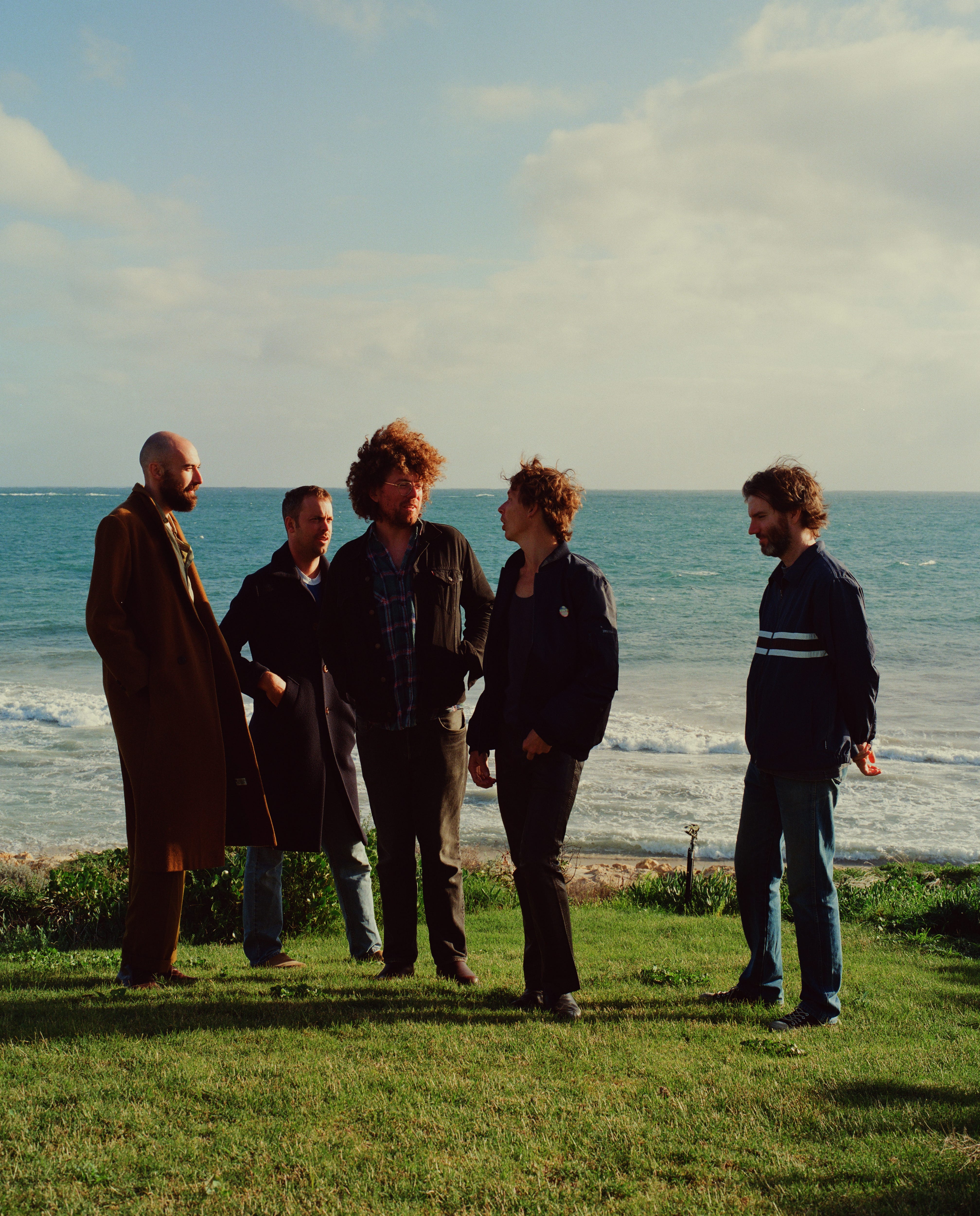
I try to get Nick Allbrook to drop his veil by asking him a question: what would he think of himself if he met himself at a party?2
“At this point, I’d have a pretty benign view of myself, I’d think, ‘there’s a nice young man’. I reckon in the past it might have been a bit more, maybe I would have thought something more extreme,” he says, before pinpointing a moment in time.
“I remember looking at myself in the mirror when I had taken a heroic dose of mushrooms, and I think for the first time in my life just seeing Nick and being like, ‘Hey, he’s a pretty cool guy. Just doing his thing, making music. He looks a little bit disheveled, probably carrying a bit of baggage but, you know, friendly enough.”
I’ve spent a lot of time since my conversation with Allbrook trying to wrestle with what Terrestrials is, exactly. It’s a great album, but beyond that I’m not sure. There’s one angle that sees it as a deeply urgent, searing treatise on Australian identity. Or maybe it’s just a really fun album that goths can listen to over some frothies.
After agonising on it for a while, I think Allbrook himself gave me the answer:
“Hey, that’s sort of what the album’s about, which is nothing,” he says. “It’s just people being messy and this constantly morphing reflection of yourself.”
The official position of Bad Scene: mushrooms, optional.3
‘Terrestrials’ is out June 19 via Mangovision/Secretly Distribution. Pre-save or pre-order the album here.
Two communities I unequivocally know will mess me up if I get on their bad side.
Flagrantly, openly, stolen from Nick Allbrook himself in an artist-on-artist interview with Peter Bibby. Nick’s response: “That’s a really hard question, sorry Peter.”
I'm way too scared of the world to do this, which is something I just need to state for transparency, and/or for any employers and/or relatives reading this.