


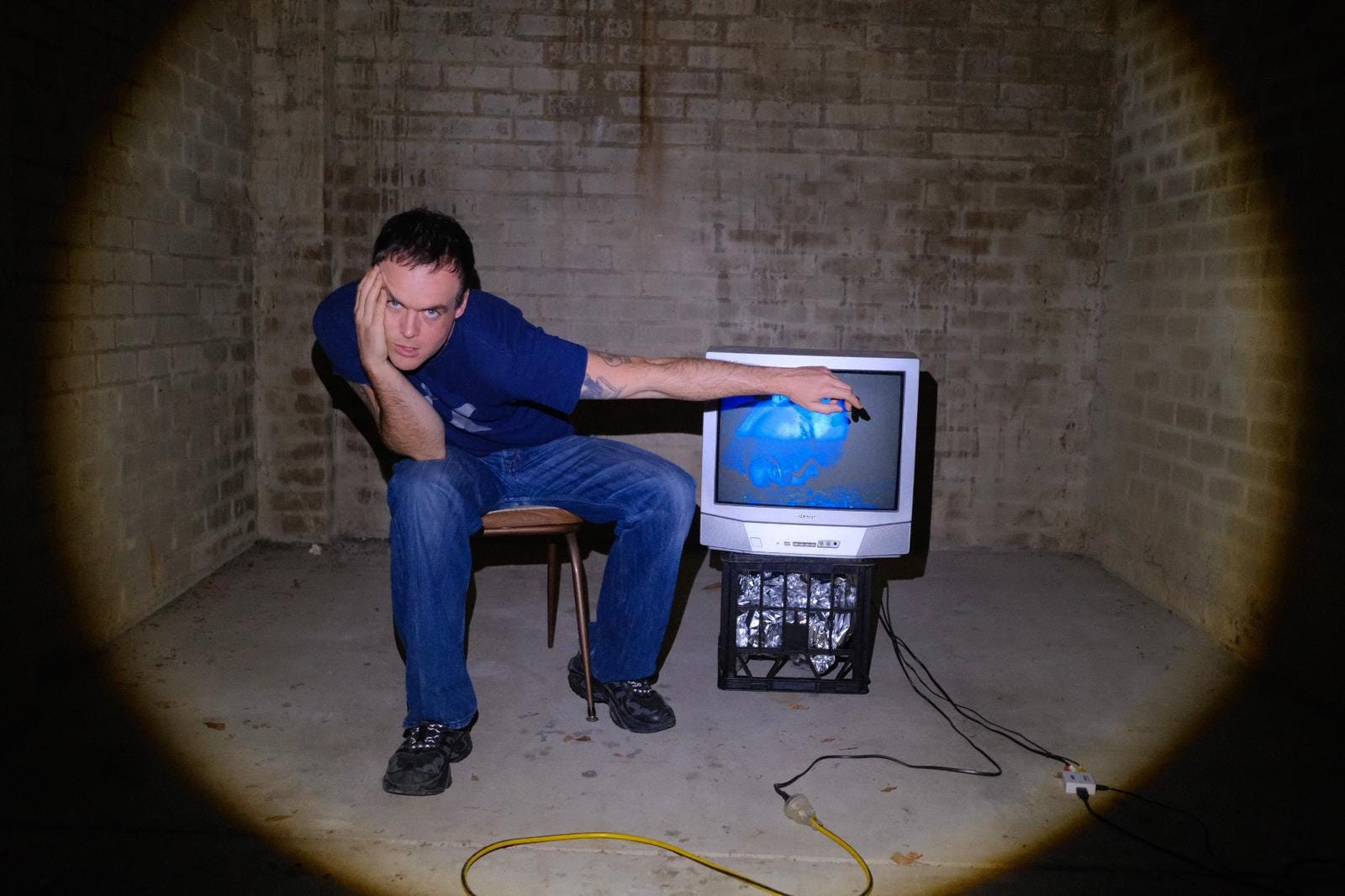
To those who weren’t watching closely, DC Maxwell might seemingly have appeared out of nowhere. For me, that moment came around June last year. A writer had mentioned him in passing,1 and a week later I was walking down Smith Street when I was met by a steady stream of achromatic posters plastered on graffiti-kissed walls.
It was simple but striking — “WHO IS JESUS’ SON?” with DC Maxwell’s name printed small at the bottom. I was taken by its ubiquity, the sheer hustle to monopolise the street poster space in Collingwood, which boasts more posters than people per square metre.2
If you followed the white rabbit, you’d wind up on YouTube watching the music video for ‘Jesus’ Son’, the lead single off DC Maxwell’s second album The Singer (releasing May 22).
The song is a gem. It lulls you in with a few dainty ‘Wonderwall’-esque strums before detonating into a crunchy guitar and crashing drums. In the clip, you get eyes on Maxwell stalking the grimy, empty underground of Flinders Street Station late at night, writhing and twitching like a man possessed. The scant few commuters around steer clear and away, averting their gaze as Maxwell spins and kicks, his shirt, jacket and tie shooting off in different directions.
It’s a hell of an introduction.
Even for those who who had been following DC Maxwell, ever since he was leading Auckland punk project Roidz, this iteration felt like something brand new. The artist we hear on ‘Jesus’ Son’ feels carnal, born and raised in those train station catacombs.
“When I released ‘Jesus’ Son’ as a single, because I hadn’t released music for a long time, they’re like, ‘Oh my god, has DC Maxwell gone Christian rock?’” DC Maxwell laughs over Zoom. “I’d be like, ‘No! ‘Jesus’ Son’ is a Lou Reed lyric that was then picked up by Dennis Johnson to talk about the holy synergy of heroin addiction!”3
The song itself works the space between euphoria and agony. “I’ve seen heaven in a broken glass,” Maxwell yelps on the chorus. He sings of ‘twist[ing] the fruit until it bleeds like just a wound’, one of a few bloody images across The Singer. It’s a record that fixates on the final stanza: fading light, death itself, and the unknowns of what comes afterwards.
“I’m not explicitly a religious person myself, but I’m very interested in the language of religion. It’s kind of this language that is ready-made for end times,” he tells me.
“In the music scene, religious people are in the minority these days, and people really struggle to talk about that feeling of, ‘Oh my god, it feels like the fucking world is ending. It feels like love is not enough, it feels like God has forsaken us’. Even then, I couldn’t express that feeling without reaching for God, that metaphor.”
Maxwell acknowledges he’s far from the first to do it — he points to Nick Cave and, more recently, Cameron Winter (although, he notes, Heavy Metal came out after he’d written The Singer). But even within the well-trodden grass of literary men singing about God, Maxwell finds his own garden. There’s more pomp than Winter and he’s more grounded than Cave. DC Maxwell doesn’t feel like a deity in disguise, but he doesn’t wilt under the singe of the spotlight.
It’s the sort of gravity that Maxwell has spent 15 years developing. With Roidz, Maxwell learned the art of being a rock frontman — loud, abrasive, and fully committed, even when perhaps you shouldn’t be (i.e. stage diving to concrete to a disapproving crowd, three times, until concussion defeats teenage ego). Roidz found a nice lane of indie success, but the project ended in 2020 with the death of Reuben Winter, Maxwell’s close friend and the band’s guitarist.
“I was very sad and depressed, so much so that I didn’t realise it,” Maxwell says of that period. After living and breathing music for nearly a decade, he stepped away entirely for nearly three years. When he came back to making music, he found catharsis in writing from the perspectives of different characters.
Unlocked, it resulted in what became his first album as DC Maxwell: 2023’s Lone Rider. It’s a touching record that achieves a deft type of emotional sleight of hand: through dressing its songs as stories with a cast of characters, Maxwell works through raw nerves in a way that never feels too confronting or loaded. The Singer refuses to make the same compromises.
“This album is a lot more direct and a lot more from the heart. It’s been scary at times, but it feels really awesome that it’s coming out,” Maxwell says.
The Singer splits the middle. It’s not exactly autobiographical, but the character work doesn’t feel so much like a costume this time around.
I point out that it’s been a period of immense change for Maxwell since releasing Lone Rider — not only has he moved to Melbourne, but he’s gotten married.
“Getting married changed my perception of what a love song could be,” he says. “I realised that being married is not all roses, soft lighting and strings playing. There’s a lot of fear in declaring to the world that you love this person and you want to spend your life with them.”
Maxwell quotes a character from the Bill Callahan song ‘Pigeons’ — “When you are dating you only see each other and the rest of us can go to hell, but when you are married, you are married to the whole world.”
“I think that’s been my experience, marriage has really sharpened my fear and my love for the world in general,” Maxwell says, leaning back in his chair. “God, I feel like I should be speaking at youth groups.”
There’s a run of three songs, specifically, that strike me as the most loved up. ‘Golden Light’ and ‘Funeral Suit’, both of which feature Hatchie on backing vocals, are odes to fear and vulnerability. The track that follows — ‘Half Real’ — takes on all that weight and more.
‘Half Real’ is a magical song both in the way it sounds and the story behind it. It’s a collaboration with Will Oldham, one of Maxwell’s idols in music and a titan of American songwriter. It started with Maxwell planning a trip to Los Angeles and cold emailing Oldham asking if he could open while in town.
“He sent back a really nice reply, ‘Hey, we’ve already got an opener sorted but thank you for reaching out, I really appreciate it’. So I just fully switched it and was like, ‘Oh okay, if I can’t open for your show, how about you come into the studio and we do a duet together? This is the song.’”
Maxwell hastily uploaded a “really bad recording” of ‘Half Real’ as a work-in-progress, which Oldham loved. Then, fate did its thing: Oldham was staying a short walk away from the studio Maxwell was recording at in Los Angeles and could swing by to record with him.4
“I saw Will Oldham skip across the road and he was sparkling in the sun, because he still had all the glitter on his face from the show he had played the night before. It was just an amazing moment.”
It’s the sort of story that feels a little unreal, but it typifies the power of DC Maxwell — he’s can take over every wall in Collingwood, or conjure a vacant Flinders Street Station underpass, or manifest a sparkling Bonnie “Prince” Billy. He can write a record wall-to-wall in death, doom and gloom, and have you leaving the listen feeling lighter than you entered. Just, whatever you do, don’t call it Christian rock.
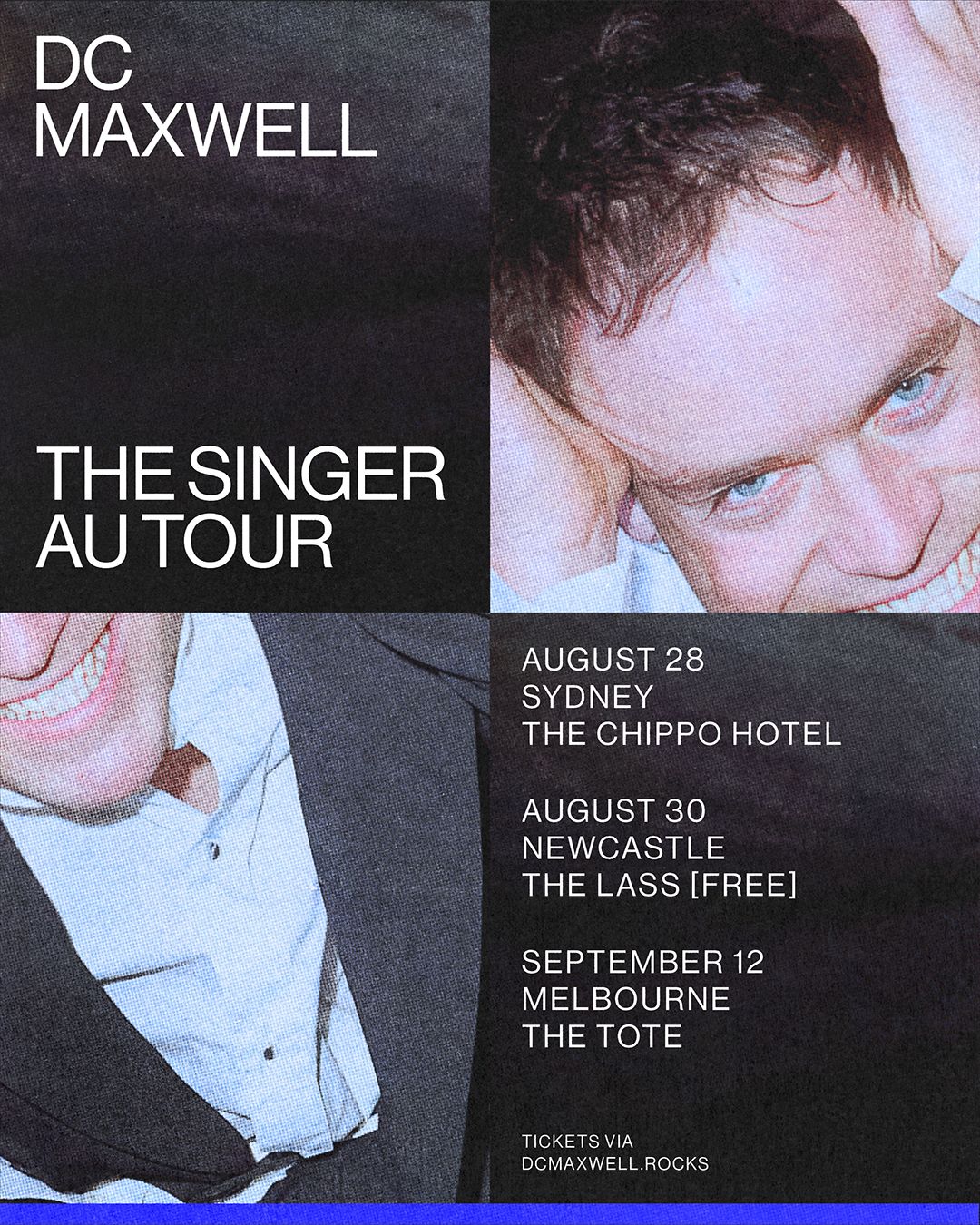
‘The Singer’ is out May 22. Pre-save here. DC Maxwell is touring Sydney, Newcastle and Melbourne from August 28 (tickets). You can also find him on Substack at DC Dispatches.
Shoutout Ben Madden, go see him talk about music and (maybe) SuperCoach in Northcote this week.
I’ll be honest, I also did appreciate the correct use of apostrophe in “Jesus’ Son”.
Side note: Jesus’ Son by Dennis Johnson — good book!
“Which is crazy in any city, but in Los Angeles where no one walks anywhere, it’s pretty insane.”