

Bad World’s Timmy Lodhi on breaking rules, the internet and hardcore
One of the best bands in Bay Area hardcore is back with a brilliant new EP, a new label and plenty more on the horizon.

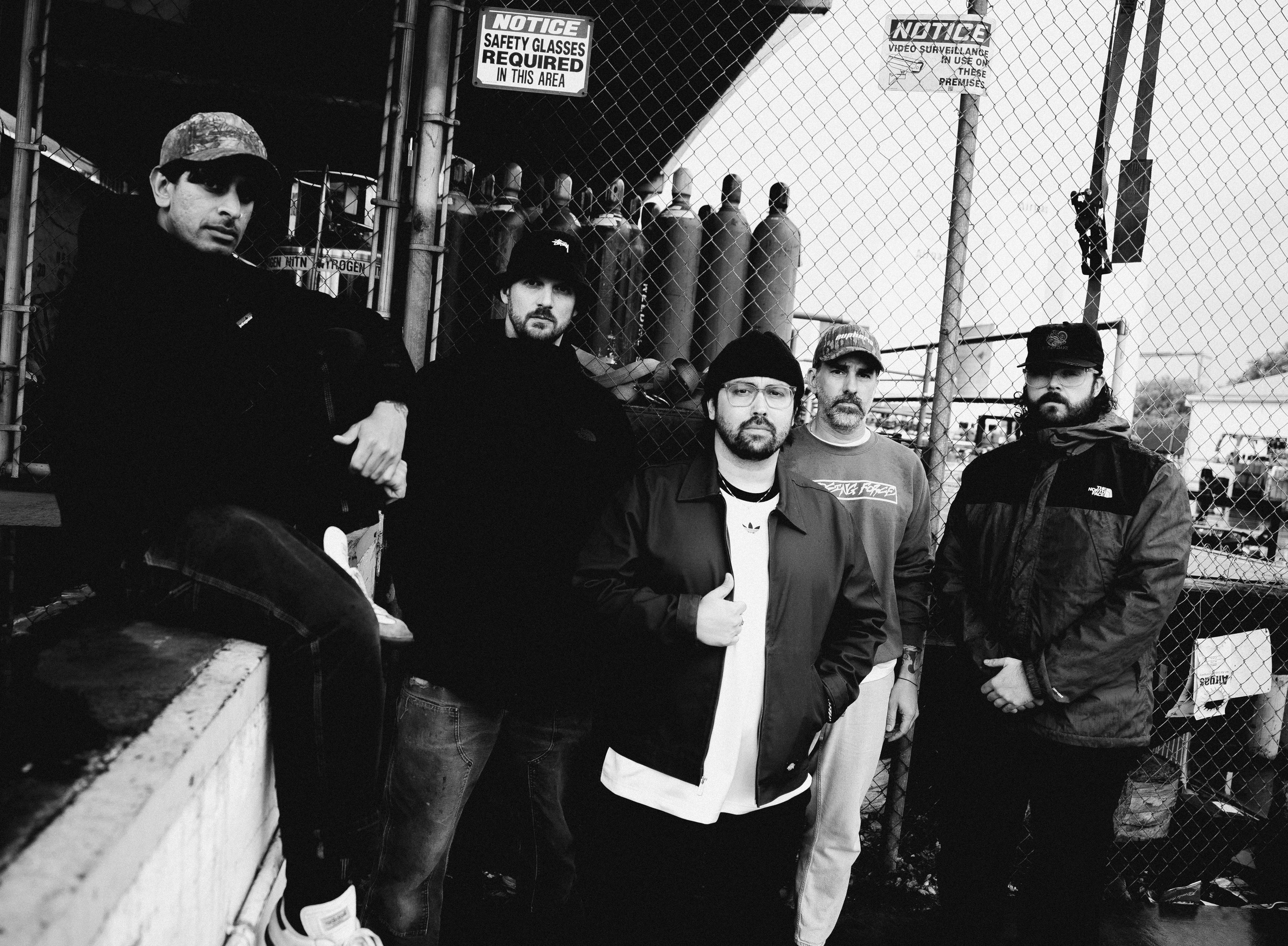
“I’m so confused as to why you hit me up about this,” Timmy Lodhi says, grinning and looking off-screen from his Bay Area home. “We’ve never played Australia, we haven’t even been close. I mean, we left the West Coast for the first time in April.”1
Here’s the reason: Timmy Lodhi’s band fucking rips. Bad World, who first rose to prominence as Bite the Hand, have been blasting eardrum-rattling hardcore since the pandemic. As soon as I heard the title track of their new EP Maker of Rules (released last Friday), with its muscular riffs and frenetic pace, I went on the hunt for Lodhi’s email.
Maker of Rules is the first proper release the band has put out since changing their name about a year ago, something they were forced into when a band of the same name sent them a cease-and-desist (how very punk of them). While the then-newly minted Bad World put out a song around then, it felt like most of the oxygen got sucked up by the scandal and the music never had the chance to breathe.
Which is a shame. Bad World have been putting out bangers since Lodhi started the band during the pandemic, and they’ve steadily risen to be one of the must-hear bands on the West Coast. On Maker of Rules, Bad World sound fresh and energised — even if the songs have actually been on the shelf for a hot minute.
“These songs have been sitting around for like years, which is so sad. It’s so long, but it’ll all be worth it,” Lodhi tells me. “It’s frustrating from our perspective how long we’ve been sitting on these, but we’re just excited to get the music out.”
Maker of Rules follows the established process for Bad World: Lodhi brings the “bones” of songs to the table and the band iterates from there. The EP is a sprint — the title track, a song featuring Ben Cook of No Warning,2 and a cover of Only Living Witness’ ‘Nineveh’, which came at the behest of bassist Travis Pacheco.
“As soon as he suggested it, it was very much an immediate yes from everybody in the band. We all love that band, we all love that record, Prone Mortal Form, and that song in particular.”
The EP marks a new chapter in many ways for Bad World. Not only is it the first substance release under the Bad World name, it’s also their debut on the routinely brilliant Denver label Convulse Records, helmed by Adam Croft of Destiny Bond. Everything prior had been self-released on Lodhi’s Big Bite Records.
“When you run a record label, but you’re also in a band, and you’re putting your own band’s music out, it sort of doesn’t feel like an official label release,” he says. “Working with Convulse is really exciting, because I don’t have to worry about the ordering of records or any of the backend stuff or the distro. We send in the songs, we send in the artwork, and Adam from Convulse has been handling it.”
That’s a change of pace for Lodhi, who has been doing this hardcore thing for well over a decade. He has been hands-on with everything from the music to the media to the music videos to the flyers to booking shows to social media to designing merch, just about everything in the scaffolding of being a band.
That experience gave Lodhi the skill set to launch his own label, the aforementioned Big Bite Records, but it has also left him with a workload that leaves him stretched thin. I ask Lodhi how he manages to keep tabs on as many bands as he does, despite the workload.
“It’s hard, for sure, I wouldn’t say it’s easy. I’m always trying to keep tabs. I find myself on Reddit a little too much the last couple of weeks in particular, it’s been a bit of a nightmare, so I am trying to stay away, but I do try to keep up,” he says.
And, well, since Lodhi brought up Reddit, I take the chance to ask about a post that picked up traction on r/hardcore — a Bad World Instagram Story that mocked Balmora’s limp response to allegations that their guitarist groomed a minor.
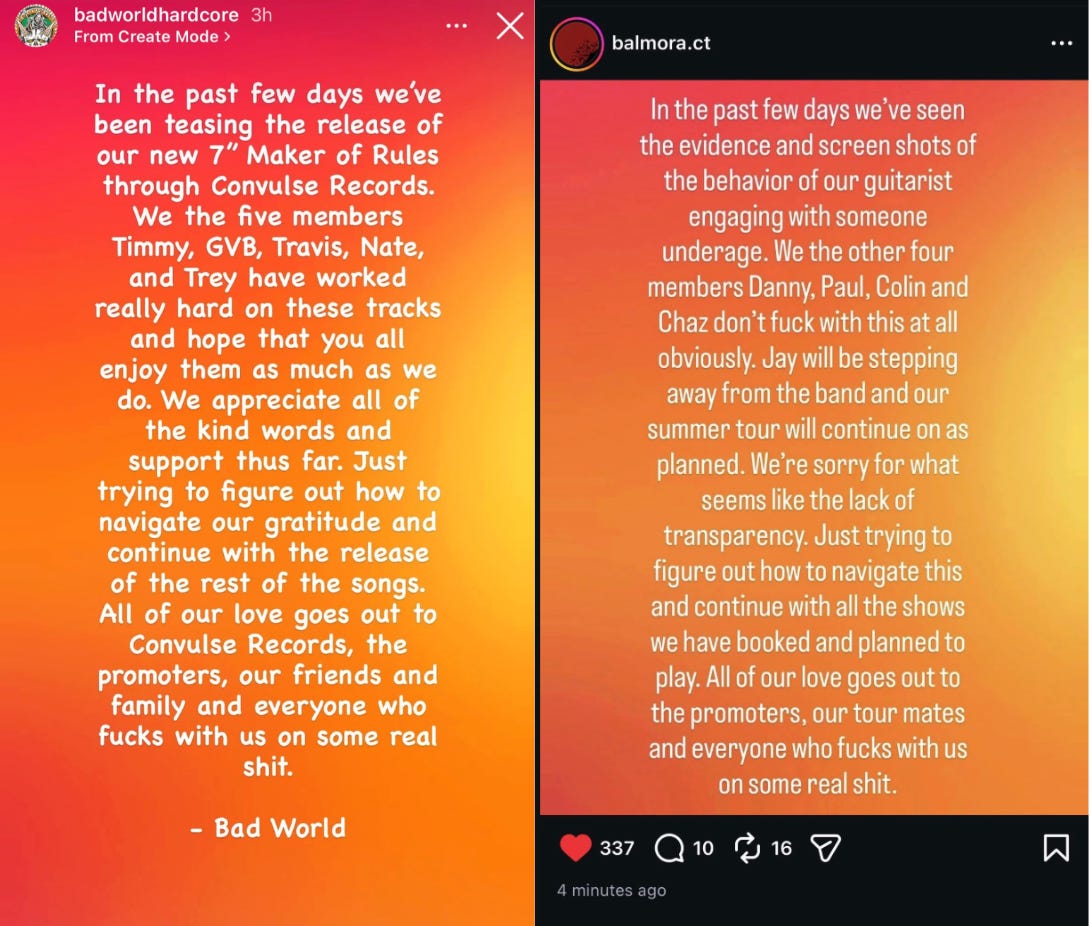
Lodhi observes that conversation-starting shitposts like that, which received a slew of amused responses, seem to be the real needle-movers for bands in today’s algorithm economy.
“I’m very cognisant of those moments because I’ve seen it happen to us as a band in very small ways, and I think it was a very big lesson for me,” Lodhi says. He’s speaking indirectly of the name change, which he “doesn’t want to get into too much”, but admits the online chatter following that saga helped the band “grow exponentially”.
“I’ve been doing music for many, many years … right now, it’s really, really hard to break through and have people care about what you’re actually sincerely doing if you’re not backed by some sort of label or have some support,” he says.
“There’s this very big thick line that separates bands that are able to break through and bands who are stuck under the blanket of the algorithm that are just not getting their music heard … Even with our band, I’m very grateful because things are going well for the most part, but if we had a ‘banana suit moment’ our shit would be exploding right now.”
The ‘banana suit moment’ in question, for those mercifully unaware, refers to End It frontman Akil Godsey, friend of Bad Scene, siccing a crowd on an audience member who inexplicably showed up to their show in a banana suit.
Some thought it was amusing and moved on, some adhered to the doctrine of ‘fuck around and find out’, and some — the loudest — thought it was the most abhorrent, awful thing they’d ever seen.3
“It’s this weird dichotomy of internet hardcore versus real life hardcore. They’re very different, I think sometimes people forget that. You see all this discourse right now about the banana suit or whatever, and people are getting so uptight and serious, and this isn’t really a thing in the real world,” Lodhi says.
“If you go to hardcore shows, this isn’t a problem, it’s never been a problem. It’s just one moment that got taken out of context and has turned into a joke for a lot of people, then a lot of people are taking it very seriously.”
Forgive the internet digression. It’s not very hardcore, I know. But Lodhi, who is in his mid-thirties, has been around the block for just the right amount of time: he knows how things used to be, but is also well-versed in the digital world. I posit that gaming the algorithm wasn’t something that, say, Terror had to ever reckon with.
“No, no, dude, they were just rough, putting fucking solid albums out that people were like stoked on,” he says. “Whether people want to admit it or not, since the pandemic hardcore has changed and the internet has played a huge role in its change and its growth.”
“There’s a lot of people who are like, ‘Well, back in my day it didn’t used to be like this’ and it’s like, yeah, back in your day Monster wasn’t sponsoring the Drain tour. Things are different now and we can’t go back, you either learn to grow or you sink with it.”
Lodhi’s entry into hardcore came at a much simpler time. He was, as he tells me, a studded jacket-clad punk with a full mohawk whose early loves include The Casualties, The Unseen and The Exploited. That affinity extended to hardcore when he saw local legends Sabertooth Zombie play the lobby at The Phoenix Theater in Petaluma.4
“It was the most violent thing I’ve ever seen in a room that was maybe 20 feet by 10 feet and I was so blown away,” Lodhi says, awestruck two decades on. “At the time, I was confused — I didn’t know if I liked it or not — but over time I started listening to more hardcore bands.”
That led to Lodhi starting Strike To Survive, which furthered his ravenous exploration of hardcore. He name-checks Blacklisted, Have Heart, Verse and Australia’s own Miles Away for shifting his perspective, scratching an itch he’d looked for in punk but “harder and faster and more melodic and heavier”.
“It was just everything I thought I wanted punk to be, but it was actualised,” he beams.
I ask Lodhi, who is of Pakistani heritage, how his parents took to his punk phase. Based on personal experience, South Asian families aren’t always the biggest fans of punk rock (or, in my case, a very aggressive Wu-Tang phase at age 13).
“Well, my question for you is, do you have siblings, or are you the oldest?” Lodhi asks. I’m the oldest.
“That’s why you were fucked,” he laughs. “I have two older sisters, so I had to bear less of the brunt from my parents.”
Lodhi’s introduction to music was “2Pac, Nas, all the 90s R&B stuff” and Bollywood music, down to choreographed dancing at his cousins’ weddings.
“When I was old enough to become my own thing, I very much quickly became the black sheep of the family,” he says, attributing the change to his friends at the time — “young white pimply stoner kids from Northern California”.
Falling in with that crowd also translated to actual trouble, a “dark period” in which Lodhi was arrested for graffiti. When he started showing an interest in learning guitar, his parents threw their support behind the venture. Lodhi speculates they were particularly stoked to see him pursue something that might keep him away from mischief.
“My mum actually dyed a blonde skunk strip down the middle of my hair, and my dad bought me my first guitar and an amp. He was driving me to go play my very first punk shows at music shops in Northern California, so they were always supportive.”
As our conversation winds up, I ask Lodhi about a roadmap he laid out on a podcast over a year ago: an EP, then a full-length. Lodhi grins at the mention of it.
“Oh my god, yes, it’s on the way,” he says. “I want to start off by saying writing a full-length is a very daunting task. It is a challenging task to write that many songs that can fit together so well, that play off of each other so well, that feels overall cohesive, but it is a big important step for a hardcore band.”
Bad World has over 12 songs written and is in the process of fine-tuning before potentially recording in the next few months. As Lodhi tells me, they won’t rush the process.
“I’m a control freak about everything I do. The reason that I started this band was because I needed to have a project that I can have creative control over, because so many of the bands that I was a part of broke up or became confused about what we wanted to do because everybody had input,” he says. “By trying to satisfy everybody’s creative ideas, it just became a weird hodgepodge of something that didn’t make any sense.”5
Those tendencies make the hard task of navigating this fractured, too-online world of making, releasing and promoting music even harder. But Timmy Lodhi shows, both in conversation and with guitar in hand, that he’s up to the challenge — now someone please send this interview as viral as that banana suit clip, please.
‘Maker of Rules’ is out now via Convulse Records. Buy or stream it here.
Shoutout Timmy for immediately agreeing to jump on the call despite all this, by the way. What a guy.
Timmy on how the collaboration came together: “I just hit him up, and I said, ‘Hey, dude, my band is dropping an EP, we'd love to have you, here's the song, let me know what you think,’ and he was super down. He cracked it out during this, like, big touring circuit that he was, I think, tour managing an EDM artist at the time in Portugal… so he somehow managed to find time to like record these vocals during that tour.
Strangely, that crowd doesn't seem to have as much smoke for the dozens upon dozens of explicitly racist comments left on everything Akil and the band has posted, two weeks and counting since the incident. Just noticing!
In a sweet development, Timmy now counts Sabertooth Zombie as good friends — they featured on a Bad World song and he even had a stoner rock side-project, The Vibrating Antennas, with members of the Sabertooth.
“Don’t I know it,” says the control freak who also started his own thing with a name starting with ‘Bad’.